(今回は外人に温泉のコンセプトを説明するので、英語オンリーで行きます。)
I've mentioned onsen hot springs several times in the past. It is rather unusual concept in the US, and it goes beyond the idea of "public bath."
(For obvious reasons, I do not have photographs for this entry...)
Japan is an island nation with considerable volcanic activities. Although this creates some major isues (volcanic eruptions, earthquakes, tsunamis, etc.), the Japanese can take consolation in enjoying natural hot springs as a byproduct of these dangerous heat-induced activities.
As the soil composition varies based on location and depth, the mineral composition of the onsen varies.
Onsen facilities have multiple areas. The first is the locker room, where in addition to changing, you can also groom yourself. Once in the onsen area, the first place where you would need to go is the washing area. As bath is communal, it is important that each bather go to the washing area and thoroughly wash their bodies.
Once cleansed, bathers are ready to enjoy the amenities, which may include bath with different mineral compositions, area with jacuzzi-like jet stream, soft bubbles, steam room, spa, cold bath, and if lucky, outdoor "rotenburo." Again, it is important to note that after going into the steam room or spa, one need to shower off sweat before re-entering communal bath.
On 11/4/08, I stayed at Hotel Grantia in Akita City. One night stay included single room, set dinner, breakfast buffet, and unlimited access to the hot springs for a very reasonable price of $70. Here is the Japanese site.
In this particular onsen, the color is rust due to the composition of sodium (natrium). The bath temperature is 92.5F with Ph level of +7.5. These properties are said to be ideal to treat fatigue, muscle ache, joint ache, and indigestion, among others. Naturally, I spent considerable time in the evening and following morning relaxing!
Here is the floor plan. Scrolling over dotted areas will open the photographs.
The following night, my stay at Také No Tsuyu allowed me to visit Yupoka Onsen on the adjoining property. As you may recall, construction of Yupoka resulted in a certain accident. Nevertheless, Aisawa-san was more than happy to take me there in the evening of the 5th and morning of the 6th. The entry fee was about $4.00 per visit, and in the morning, I ordered "breakfast set" ($9.50) which also included buffet-style Japanese traditional breakfast.
Unlike the onsen at Grantia hotel, the water was clear. Although I was given about one hour on my each visit, the time seemed to fly very quickly. Perhaps my best memory was sitting in the outside "rotenburo" during the evening, with a lone pine tree and being bathed by a moonbeam from a full moon. Only thing lacking was a bottle of Hakuro Suishu...
Showing posts sorted by relevance for query onsen. Sort by date Show all posts
Showing posts sorted by relevance for query onsen. Sort by date Show all posts
Thursday, January 01, 2009

Thursday, December 10, 2009
11/26/09: Day 7 in Japan, Part II - Town of Yufuin
 The town of Yufuin, along with neighboring Beppu, is famous as resort town for onsen hot springs. Its rusticness is evident from the design of their rail station.
 To further accentuate the point, there is a foot bath onsen on the platform.
  Surrounded by the moutains, the view is spectacular. Clean air, calming vista, and relaxing hot springs are just what the doctor ordered.
  Walking around the town, you can easily locate the hot springs. How do I know? Look for the plumes of steam!
  One thing to keep in mind about visiting Yufuin: as onsen ryokan (inn) typically include kasiseki dinner, the town becomes very quiet around 5:00 pm as guests hurry back to take a quick dip in onsen before dinner. By 5:30, most of the shops and restaurants are closed. For those staying in a ryokan without dinner accomodations, they ought to head towards the train station to find restaurants that are open.
Sunday, December 13, 2009
11/27/09: Day 8 in Japan - Leaving Yufuin
 While Nurukawa Onsen did not come with dinner, it did come with breakfast. I made reservation for the earliest alloted time. Not surprisingly, the breakfast was the traditional Japanese arrangement.
 Poached egg in dashi? In Japan, appropriately, it is called "onsen" eggs.
 After digesting for 1/2 hour, it was time for a quick dip in the onsen. There aren't too many better ways to start one's morning than taking an outdoor bath at the foot of glorious mountain in the autumn, especially when it's 50 degrees outside.
 On the way out, I noticed this Japanese maple. Wa, or harmony, is everywhere if you just take a time to look around...
 Down by Lake Kirin, the ducks were washing themselves amidst the rising mist.
 Rustic sign at the train station.
 The train we were scheduled to take was the retro-styled "The Forst of Yufuin."
 In Japan, many of the trains operates with reserved seating. I was assigned to Car #2.
 Having lunch on the train is one of the pleasures of the Japanese long distance rail travel. The stations vend lunch boxes with local flavor. I chose tender Bungo beef and rice bento.
 Wednesday, November 25, 2009
11/23/09: Day 4 in Japan - Arriving in Hakata
Not unexpectedly, my eyes opened around 7:30, but I woke up around 9:30 only because I had to check out by 10:00.
I skipped breakfast, but that's not a bad thing in retrospect, based on the pace I am helping out Japanese food industry.
 After leaving the comforts of bed, I spent couple of hours by Hiroshima Station working on rehydration. Interestingly, the city of Kyoto was promoting tourism, so there was a lady dressed as geisha and a gentleman clad in the coat of Shinsengumi.
 My next stop is Hakata in Fukuoka prefecture, located on the island of Kyushu. This will be my first visit on the island where my father's side of the family is based.
 As my appetizer was virtually nonexistant, my lunch included 3 different breads. First was the bacon and cheese roll...
 ...followed by fried chicken with tartare sauce on a roll...
 ...and curry bread, a must-eat item when in Japan.
 After checking into the hotel, it was time to relax and detox by visitig Seiryu Onsen hot springs, recommended by a friend.
 Housed in a traditional-looking lodge, the onsen featured 6 different hotsprings (2 inside, 4 outside) and 2 spa facilities. The onsen is located about 50 minutes from Hakata Station, but thankfully, there is a free shuttle bus that runs hourly. This visit was much needed!
 Hakata is famous for their tonkotsu ramen, which is made from deriving broth from pork. In a lucky coincidence, the restaurant my friend recommended, Fukuchan, was located just 2 blocks away from the hotel.
 As my appetite recovered sufficiently, I ordered Char-Siu Tonkotsu Ramen.
 The taste did not disappoint, the firm noodle pairing well with creamy but well-balanced soup.
 Of course, I had to have their gyoza as well.
 On the way home, there was a tunnel running under and across the rail tracks. Within the tunnel was a mural, and one section featured Kondo Isami, leader of Shinsengumi. Man, they're everywhere!
I skipped breakfast, but that's not a bad thing in retrospect, based on the pace I am helping out Japanese food industry.
 After leaving the comforts of bed, I spent couple of hours by Hiroshima Station working on rehydration. Interestingly, the city of Kyoto was promoting tourism, so there was a lady dressed as geisha and a gentleman clad in the coat of Shinsengumi.
 My next stop is Hakata in Fukuoka prefecture, located on the island of Kyushu. This will be my first visit on the island where my father's side of the family is based.
 As my appetizer was virtually nonexistant, my lunch included 3 different breads. First was the bacon and cheese roll...
 ...followed by fried chicken with tartare sauce on a roll...
 ...and curry bread, a must-eat item when in Japan.
 After checking into the hotel, it was time to relax and detox by visitig Seiryu Onsen hot springs, recommended by a friend.
 Housed in a traditional-looking lodge, the onsen featured 6 different hotsprings (2 inside, 4 outside) and 2 spa facilities. The onsen is located about 50 minutes from Hakata Station, but thankfully, there is a free shuttle bus that runs hourly. This visit was much needed!
 Hakata is famous for their tonkotsu ramen, which is made from deriving broth from pork. In a lucky coincidence, the restaurant my friend recommended, Fukuchan, was located just 2 blocks away from the hotel.
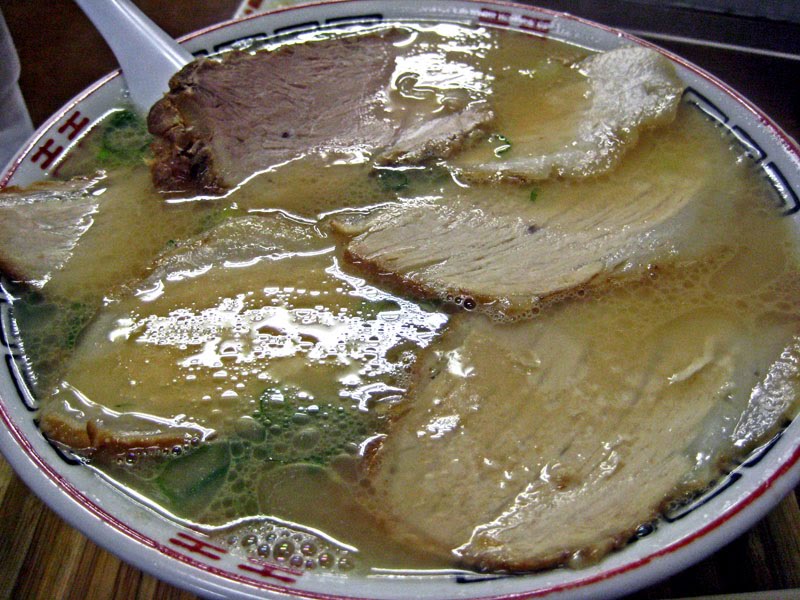 As my appetite recovered sufficiently, I ordered Char-Siu Tonkotsu Ramen.
 The taste did not disappoint, the firm noodle pairing well with creamy but well-balanced soup.
 Of course, I had to have their gyoza as well.
 On the way home, there was a tunnel running under and across the rail tracks. Within the tunnel was a mural, and one section featured Kondo Isami, leader of Shinsengumi. Man, they're everywhere!
Sunday, December 14, 2008
11/5/08: Day 6 in Japan Part I - Visiting Také No Tsuyu Brewery

After a nice morning dip in the onsen hot spring, I was on my way to Akita Station to board Shinkansen. On my agenda today is visiting Také No Tsuyu Brewery, located in Haguro Village in the city of Tsuruoka in Yamagata Prefecture. Welcoming me at Tsuruoka Station was Aisawa-san.
今朝は温泉に入り、秋田駅へ。今日は竹の露合資会社の見学の為、山形県鶴岡市羽黒町へ向う予定。鶴岡駅では相沢さんがお迎えに来てくれた。
 First thing we did after arriving at the brewery was to go out for lunch. Aisawa-san chose a local restaurant located amidst rice paddies, known for their hand-made soba. "Yama No Sobaya" specializes in thick and coarse "inaka-style" soba. We ordered the hot version, with its generous topping of roast pork and fried tofu. The combination of flavorful soup and firm texture of the soba was simply out of this world.
蔵元に到着したら真っ先にランチ。相沢さんのお勧めは田んぼに囲まれた「山の蕎麦屋」で田舎蕎麦。蕎麦は自家栽培で、ジューシーなチャーシューと油揚げ付き。味が確りした蕎麦汁と蕎麦の歯ごたえが最高。
 Mr. and Mrs. Aisawa in front of the entrance to the brewery.
相沢夫婦と蔵の前で記念写真。
 My first impression about Také No Tsuyu is extremely clean. That is not to say that other breweries are filthy, but at Také No Tsuyu, nothing seemed out of place.
蔵の印象と言えば、清潔感が溢れる。これは決して他の蔵が不潔と言う事では無く、竹の露の全てがキッチリされているからだ。
 The first place Aisawa-san showed me was the tank where they keep well water. (The next entry will be dedicated to the water and rice of Také No Tsuyu.) Needless to say, Aisawa-san takes great pride in his water.
蔵の見学は水の説明から始まった。これが井戸水の貯蔵タンク。(次のポストは竹の露の水・米の詳しい説明。)相沢さんの話を聞くと、「水は命」の意味が十分解る。
 This machine steams then cools the rice.
米を蒸してから冷やすマシーン。
 Tank for the yeast starter. The aroma is quite something.
酒母タンク。酒母の香りも最高。
 Nestled in the back of the brewery are fermentation tanks.
蔵の置くには仕込みのタンクが。
 Right outside this room is a bamboo forest that inspired the name of the brewery (loosely translated as, "Bamboo Dew.") The shade offered by bamboo forest and cool draft descending Mt. Gassan provide ideal environment for aging and storing saké, even over the summer.
仕込みタンク部屋を囲んでいるのは蔵の名前の由来になる竹林。竹林の木陰と月山おろしが夏でも醗酵・貯蔵に快適な環境を作ってくれる。
 This machine manages cultivation of koji mold. Their data management is very meticulous.
これは純米酒用の麹を管理する機械。竹の露ではデータの管理も徹底している。
 Daiginjo-grade koji mold is manually managed by brewers in koji room in the 2nd floor.
大吟醸用の麹は2階の麹室で。勿論、職人の手作業。
 After the tour, I went to onsen hot spring, then Aisawa-san took us for sushi dinner. Také No Tsuyu sakés went exceptionally well with the finely prepared sashimi by the sushi master of Happo Sushi. As we came straight from the hot springs, we don't have pictures for obvious reasons. After returning to brewery, we prepared for some evening work. Of course, preparation involved indulging in Hakuro Suishu sakés...
見学の後は先ず温泉。入浴後は和服へ着替えて、すし屋へ向かった。「八方すし」はマスターが繊細な腕を披露し、刺身と「竹の露」のお酒は最高のペアリング。温泉から直接向かったので、残念だが写真は無い。蔵に戻ったら、夜の作業の準備。その意味は「はくろすいしゅを」を飲むことであった...
今朝は温泉に入り、秋田駅へ。今日は竹の露合資会社の見学の為、山形県鶴岡市羽黒町へ向う予定。鶴岡駅では相沢さんがお迎えに来てくれた。
 First thing we did after arriving at the brewery was to go out for lunch. Aisawa-san chose a local restaurant located amidst rice paddies, known for their hand-made soba. "Yama No Sobaya" specializes in thick and coarse "inaka-style" soba. We ordered the hot version, with its generous topping of roast pork and fried tofu. The combination of flavorful soup and firm texture of the soba was simply out of this world.
蔵元に到着したら真っ先にランチ。相沢さんのお勧めは田んぼに囲まれた「山の蕎麦屋」で田舎蕎麦。蕎麦は自家栽培で、ジューシーなチャーシューと油揚げ付き。味が確りした蕎麦汁と蕎麦の歯ごたえが最高。
 Mr. and Mrs. Aisawa in front of the entrance to the brewery.
相沢夫婦と蔵の前で記念写真。
 My first impression about Také No Tsuyu is extremely clean. That is not to say that other breweries are filthy, but at Také No Tsuyu, nothing seemed out of place.
蔵の印象と言えば、清潔感が溢れる。これは決して他の蔵が不潔と言う事では無く、竹の露の全てがキッチリされているからだ。
 The first place Aisawa-san showed me was the tank where they keep well water. (The next entry will be dedicated to the water and rice of Také No Tsuyu.) Needless to say, Aisawa-san takes great pride in his water.
蔵の見学は水の説明から始まった。これが井戸水の貯蔵タンク。(次のポストは竹の露の水・米の詳しい説明。)相沢さんの話を聞くと、「水は命」の意味が十分解る。
 This machine steams then cools the rice.
米を蒸してから冷やすマシーン。
 Tank for the yeast starter. The aroma is quite something.
酒母タンク。酒母の香りも最高。
 Nestled in the back of the brewery are fermentation tanks.
蔵の置くには仕込みのタンクが。
 Right outside this room is a bamboo forest that inspired the name of the brewery (loosely translated as, "Bamboo Dew.") The shade offered by bamboo forest and cool draft descending Mt. Gassan provide ideal environment for aging and storing saké, even over the summer.
仕込みタンク部屋を囲んでいるのは蔵の名前の由来になる竹林。竹林の木陰と月山おろしが夏でも醗酵・貯蔵に快適な環境を作ってくれる。
 This machine manages cultivation of koji mold. Their data management is very meticulous.
これは純米酒用の麹を管理する機械。竹の露ではデータの管理も徹底している。
 Daiginjo-grade koji mold is manually managed by brewers in koji room in the 2nd floor.
大吟醸用の麹は2階の麹室で。勿論、職人の手作業。
 After the tour, I went to onsen hot spring, then Aisawa-san took us for sushi dinner. Také No Tsuyu sakés went exceptionally well with the finely prepared sashimi by the sushi master of Happo Sushi. As we came straight from the hot springs, we don't have pictures for obvious reasons. After returning to brewery, we prepared for some evening work. Of course, preparation involved indulging in Hakuro Suishu sakés...
見学の後は先ず温泉。入浴後は和服へ着替えて、すし屋へ向かった。「八方すし」はマスターが繊細な腕を披露し、刺身と「竹の露」のお酒は最高のペアリング。温泉から直接向かったので、残念だが写真は無い。蔵に戻ったら、夜の作業の準備。その意味は「はくろすいしゅを」を飲むことであった...
Monday, December 07, 2009
11/26/09: Day 7 in Japan, Part I - On to Yufuin
 After all too short stay in Kagoshima, my next destination was Yufuin in Oita prefecture. With another few hours on the road, hearty breakfast was in order...
 ...hearty and healthy, mind you...
 ...and not to mention traditional.
 After few hours, I reached Nurukawa Onsen, a rustic inn located about 20 minute walk from the train station.
 My room was the traditional tatami room.
 Before going for a walk, I had to take advantage of their onsen. Aside from the communal men/women baths, they offered several private 'family bath' units available on first-come first-serve basis. I grabbed an open-air "roten buro" overlooking the neighboring mountain.
 Just two minutes from the inn was picturesque Lake Kinrin, showing off the reflection of the foliage.
  For dinner, I was recommended "Dot to Dot" restaurant close to the train station. Generally, the place seems bit trendy, but I was sworn by their quality by a friendly shopkeeper.
 Their menu feature locally grown vegetables...
 ...as well as fresh meat from a local meat store. Many of the dishes are prepared organically, and it indeed was a feast for my stomach as well as my eyes.
 Because the restaurant had a very limited alcohol selections, I opened up a bottle of Ama No To "Umashine" upon my return. Polished to 80% and unfiltered, the saké had a light golden hue, surprisingly smooth texture, and long umami-laden flavor.
 After some time to digest, I had to take an evening bath. The attendant told me that I can try the bath unit that feature both indoor and outdoor bath.
 As the temperature was bit nippy out, the contrast with the hot spring was just right.
 There isn't much better way to relax by listening to the trickling water...
 ...while staring into the lit up Japanese maple tree in all its autumn glory.
Subscribe to:
Comments (Atom)
