Showing posts with label Saké Type - Genshu. Show all posts

Monday, January 18, 2010

11/30/09: Day 11 in Japan, Part II - Return To Tsukushi No Ko

After freshening up, it was time for dinner at one of my favorite saké-centric izaaya in Tokyo:
Tsukushi No Ko.

Love the interior!

Started with "that beer," which is a Dassai sparkling nigori.

We started with some mackeral...

...and yellow tail as the first order.

The first saké was Wada Ryu (not pictutred), as my friend who accompanied me has a last name of Wada. Following that, we went with Juyondai Yamadanishiki.

Third saké was Masurao, which is a Yamahai Junmai Ginjo from Ishikawa Prefecture. I recalled liking it very much when I visited last year.

The second order included some rice noodles and fish roe balls...

...and marinated chicken liver. Yes, it was as intense as it looks!

The fourth saké was Hakuro Suishu Nama Genshu made using Miyama Nishiki.

By this time, we were getting more thirsty, so we ordered a 1.8L size of... water. That's a water used to brew saké, sent directly from the brewery.

Next food order included the Japanese staple of "Niku Jaga," which is stewed potatoes and minced meat...

...and order of tofu and stewed pork.

The fifth saké of the evening was Fukucho "Toru Special," which is a private bottling for Tsukushi No Ko.

Fukucho is headed by female Toji, Miho-san, and her picture graces the label.

The sixth saké was Azumaichi made from Yamadanishiki polished down to 50% from Saga Prefecture in Kyushu.

We ended up drinking 2 mega bottles of water. The second bottle was from Aoki Shuzo in Niigata.

Our last food order was Japanese omlet, which is slightly slight and very fluffy. Perfect end to a perfect evening!

Sunday, January 03, 2010

11/28/09: Day 9 in Japan, Part II - Visiting Tenzan Brewery, Continued

What are these, you ask? They are pieces of tree that make up the sugidama (a.k.a., "sakabayashi"), those green or brown balls (depending on the season) you see decorated in front of breweries. It takes about 1 week between brewing to complete.

After the tour came tasting. I tried Tenzan line of saké...

...as well as Shichida line, which reflects the family name of the proprieter.

Tenzan brand is made in the traditional style. From this group, I especially enjoyed their "Extra Dry" honjozo (SMV: +10, Acidity: 1.2, Rice: Saga grown Reihou, Seimaibuai: 65%) for their sweet flavors of grain and clean, sharp, and dry finish. Interestingly, it says "saké for the guys" on the label.

Shichida brand, on the other hand, was started by Kensuké Shichida, the current Managing Director. These sakés are made in the image of what Shichida-san sees as ideal saké, and are brewed unfiltered and pasteurized once, prior to shipping. I particularly enjoyed their Junmai Ginjo Muroka Nama (SMV: +4~5, Acidity: 1.5~1.6, Rice: Yamadanishiki, Reihou, Seimaibuai: 50%). The saké had a sweet aroma of a ginjo, followed by gentle yet firm flavor.

After the tasting, Shichida-san treated me to their local gourmet: koi. Koi, as you may know, is carp. Ogi City is famous for carp, and many restaurants shuttle in diners with buses.

Appetizer comprised of locally grown ingredients. I have never had the green leaf vegetable next to the cucumber. It was incredibly crunchy, and good.

Miso soup was next, containing koi meat. They used white miso, which is milder in flavor and imparts more sweetness than the red, making it an ideal pairing for fish.

Koi served on the rocks. Koi is said to be very gamey in flavor, but the clean water and restricted diet is said to remove the intenseness. The flavor was indeed mild with excellent texture.

Shichida-san in front of Ogi City train station.
Thank you very much for your hospitality!!!

Tuesday, November 17, 2009

11/11/09: Akita Saké Tasting Event

This was the ninth installation of the Akita Saké Tasting Event. As usual, the place was packed.

One of the guest saké was the perfect opener...

I was very pleased to see Misato by Hinomaru Jozo, the saké I remember fondly from the Sixth edition of the tasting.

Kirishima-san from Joto Saké holding Akita Komachi Daiginjo, one of their top selections.

This bottle caught my attention. Sendai Bozu is made from the rice of the same namesake polished down to 50%. Evidently, it's a junmai ginjo genshu using a rice strain discovered in Miyagi prefecture in 1955. Today, its cultivation is limited to a section of one farm in the city of Odaté in Akita. The flavor expands quickly with depth, and it's a type of saké that might serve well lightly heated.

Next saké was highly controversial. Aged in barrel used to age Ay Grand Cru Champagne, chene d'argonne was a complex saké that didn't taste like saké due to its flavors that include green apples, vanilla, and spices. It's a very well-crafted saké, but far from what we're used to... for better or for worse.

No saké brought bigger smile to my face than seeing Hakuun Yuu Yuu Junmai Daiginjo by Asamai Shuzo, famous for their Ama No To label. Why the big grin? Because it brought me back to this time and place.

Monday, November 16, 2009

11/4/09: Reuter Charity Saké Event/ Robataya

Thomson Reuters Asia Pacific Employee Network hosted a charity saké tasting event to benefit victims of natural disaster in Asia. The event featured 3 breweries: Dassai, Akita Seishu, and Tenzan.

My evening started with a toast with Dassai "39" Sparkling Nigori.

My next stop was the Akita Seishu booth to see Ito-san (right) and my friend and sommelier Yang-san.

I especially enjoyed soft and smooth Matsukura Tokubetsu Junmai.

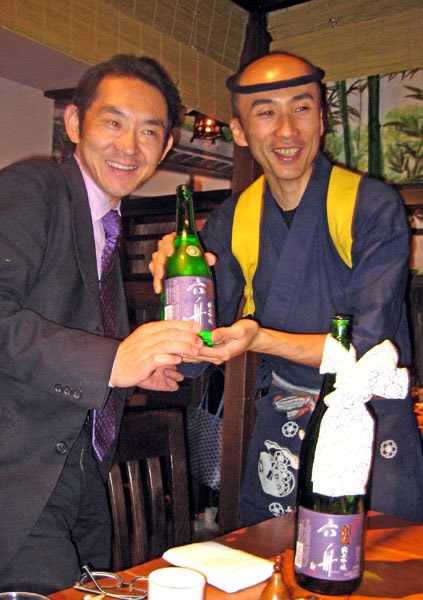
Right by the front entrance was this interesting character, who turned out to be Shichida-san from Tenzan Brewery. The design of the mask incorporates kanji characters of the brewery ("天" and "山").

Tenzan is known for their Genshu which is packaged in a bamboo leaf, but he brought Hitenzan Daiginjo and Junmai from Shichida brand.

As many of the audience was actually there for noble causes, the event featured saké lecture by Tim Sullivan to get the audience up to speed.

The lecture was followed by brewery introduction.

As the event lasted "only" two hours, some of us didn't have enough of a good time - time to plan for the next stop. We chose Robataya NY, which is the sister restaurant to Sakagura.

Once inside, a large counter awaits, lined by fresh ingredient to be grilled.

The counter and table area is separated by a decorative garden and water feature.

All the sakés that were ordered, naturally, were associated with the brewers. This one is light and delicate Rokushu Junmai Ginjo by Akita Seishu.

Don't believe we're having a good time? Well, then...

Saturday, October 03, 2009

5/19/09: Niigata Saké Selections Tasting

While sakés from Akita are getting lot of publicity in NYC, Niigata still carry a lot of clout in the world of saké.

On this date, I was able to sample quite a few sakés at the brewer tasting courtesy of Mr. and Mrs. Kobayashi, who run Niigata Saké Selections.

Mr. Saito from Kirinzan Brewery holding Kirinzan Junmai (SMV: +4, Acidity: 1.4, Rice: Gohyakumangoku, Yuki No Sei, Seimaibuai: 60%, Yeast: G9NF), one of my favorites from the tasting. While I am a big fan of their Junmai Daiginjo, the junmai more than held its own. Slightly more brawnier than the subtle and smooth junmai daiginjo, the junmai brings out the essence of the flavor of the rice.

Speaking of the junmai daiginjo, here is their highly distinctive bottle.

Here I am with Mr. Hirashima of Obata Shuzo, which is located on the Sado Island in Japan Sea. He was pouring their fruity daiginjo (SMV: +5, Acidity: 1.1, Rice: Gohyakumangoku, Seimaibuai: 50%, Yeast: #1701), and deep and balanced junmai ginjo muroka genshu (SMV: +3, Acidity: 1.7, Rice: Gohyakumangoku, Seimaibuai: 55%, Yeast: #1701), both from their Ma No Tsuru label.

The four diamond boxes on the family crest of the brewery represents rice, water, man, and "Sado Island terroir." Although tough to find in the NYC area, their sakés are worth seeking out.

It was great to see Mr. Aoki from Aoki Shuzo, who I first met 2.5 years ago. I noted with a tinge of fear in my voice that the Junmai Ginjo seems to be more fruitier compared to 2 years ago. Fear not, this was a result of changing rice from Miyamanishiki to the locally grown Koshi Tanrei, to keep with the brewery's philosophy of using local ingredients.

No, this man is NOT from Niigata (Sakurai-san from Dassai Brewery in Yamaguchi.)

We have couple of attendees representing Akita. Speaking with Mr. Kobayashi is Mr. Kakizaki from Asamai Shuzo, maker of Ama No To label, and saké sommelier Chizuko Niikawa.

Rick Smith of Sakaya, Tim Sullivan of Urbansaké, and Mrs. Kobayashi of Niigata Saké Selections.

Here I am with Mr. and Mrs. Kobayashi, who is holding a bottle of Yukikagé Tokubetsu Junmai (SMV: +4, Acidity 1.3, Rice: Gohyakumangoku, Seimaibuai: 58%, Yeast: S3). For under $30 a bottle, Yukikagé is one of the best valued quintessential Niigata saké, showing gentle and subtle expressions of rice and grain.

For these sakés and ones I couldn't mention, visitNiigata Saké Selections for further details.